Lesson 10
|
Lesson 10 - MELODY - Different Groups of Instruments (Cont.)
GARRITAN INTERACTIVE
PRINCIPLES OF ORCHESTRATION by Nikolay Rimsky-Korsakov Chapter II
MELODY Part 4 - Melody in different groups of instruments combined together (continued)
Lesson Notes: In this lesson we will continue our discussion on the combination of various groups of instruments. This lesson will conclude the lessons dealing with melody. After this lesson we will advance to harmony.
Melody in different groups of instruments. Parts doubled in octaves.
Examples of strings in octaves doubled by wood-wind also in octaves are numerous, and do not require special description; they are used according to the rules already laid down. (*1) The following are examples of melody distributed over 1, 2, 3 and 4 octaves: Score References & Musical Examples Using GPO:
No. 85. Ivan the Terrible, Beginning of Overture - Violins and 2 Clarinets playing in unison, with violas and cellos and 2 bassoons doubling an octave below.Click on Play Button below to Play from the Score
No. 86. Sadko, Section 3 - Cellos and Bass Clarinet playing in unison, with double basses and contrabassoon doubling an octave below. Click on Play Button below to Play from the Score
Other References: • cf. Example 22: The Tsar's Bride, Section 166 - Violins I and Flutes playing in unison, with Violins I and Oboes doubling an octave below. • Sadko, Section 166 - Cellos and Bassoons playing in unison, with Double basses and Contrabassoon doubling an octave below. • Sadko, Section 235 - Violas and 2 Clarinets playing in unison, with Double basses and Cellos and 2 Bassoons doubling an octave below. • The Tsar's Bride, Section 14 - Cellos and Bassoons playing in unison, with Double basses and bassoon doubling an octave below. • The Tsar's Bride, Section 81 - Violins I and Flutes playing in unison, with Violins I and Oboes doubling an octave below.  GPO Exercise - Melody in Different Groups: Violins and Winds in Octaves GPO Exercise - Melody in Different Groups: Violins and Winds in OctavesIn this exercise we will focus on the combination of wind and violins in octaves 1. Refer to the background score. For the background score click here. 2. Load the background track MP3 in your MP3 player or sequencer. For the background track MP3 click here. For a dry version if you want a more intimate sound, click here. 3. Load the given MIDI file either into a sequencer or notation program supporting GPO and assign instruments accordingly. For the MIDI file click here. 4. Load the appropriate instruments into GPO. 5. Experiment with violins in octaves using respective wind instruments suggested by RK that are best suited for this family for doubling. Try using muted violins and non-muted. If the melody you wrote is in a very high register, often one or two violins may suffice for the upper part. Thirdly you may just want to double the violin melody an octave higher with, lets say, something from the flute family. Here is one possible example: Violins in Octaves Doubled by Oboe and Flute in Octaves In three and four octaves: Score References & Musical Examples Using GPO: No. 87. Marriage of Figaro, Mozart Click on Play Button below to Play from the Score
Other References: • Servilia, Section 93 - Violas and 2 oboes in unison, with Violins and 3 Flutes playuing in unison an octave higher; and Cellos and two bassons playing in unison an octave lower. (*2) • Sheherazade, 3rd Movement, Section M - Violins II and Oboes in unison, with Violins I and Flutes playing in unison an octave higher, and Cellos and English Horn playing in unison an octave lower. Examples of Melody in thirds and sixths: Score References & Musical Examples Using GPO: No. 87 and 88 replace the original cores in the text for better illustration. Click on Play Button below to Play from the Score
Click on Play Button below to Play from the Score
Other References: • Servilia, Section 44 - Flutes and Oboes and Clarinets and Violins, divisi and in thirds. • Kashtchel, Section 90 - The same It is necessary to pay more attention to cases where, of the two parts in octaves, only one is doubled. When this method is applied to a melody in the soprano register it is better to allow the wood-wind to progress in octaves, the lower part only being doubled by one of the string groups; 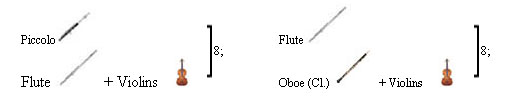 Score References & Musical Examples Using GPO: Click on Play Button below to Play from the Score
Other References: • Tsar Saltan, Section 102 - Piccolo and 2 Flutes in unison, with Violins and 3 Oboe playing in unison an octave higher. In the case of a melody in the low register demanding a sweet soft tone, the violoncellos and double basses should be made to - progress in octaves, the former doubled by a bassoon, the latter not doubled at all: Cellos and Basson in unison, with Double Basses playing an octave lower. Sometimes a composer is obliged to use this method on account of the very low register of the double bass, especially if a double bassoon is not included in his orchestral scheme.* (*3) *Note: The process of doubling strings and wood-wind in octaves (doubling flutes and violins playing an octave apart, doubling oboe and Cellos playing an octave apart, etc.) often used by the classics to obtain balance of tone, is not to be recommended, as the-tone quality of the two groups is so widely different. As a result of the ever-increasing tendency to profusion of colour, this method has recently come into fashion again, notably among the younger French composers. (Editor's note). (*4) Score References & Musical Examples Using GPO: Click on Play Button below to Play from the Score
D. Combination of strings and brass. Owing to the dissimilarity between the quality of string and brass tone, the combination of these two groups in unison can never yield such a perfect blend as that produced by the union of strings and wood-wind. When a brass and a stringed instrument progress in unison, each can be heard separately, but the instruments in each group which can be combined with the greatest amount of success are those whose respective registers correspond the most nearly; Violin + Trumpet; Viola+ Horn; Cellos + Trombones + Double basses + Tuba (for massive heavy effects). (*5) The combination of horns and 'cellos, frequently employed, produces a beautifully blended, soft quality of tone. (*6)
Click on Play Button below to Play from the Score
Other References: • Tsar Saltan, Section 98 - Violins I + Violins II + Horn E. Combination of the three groups. The combination of members of the three groups in unison is more common, the presence of the wood-wind imparting a fuller and more evenly blended tone. The question as to which group will predominate in timbre depends upon the number of instruments employed. The most natural combinations, and those most generally in use are: 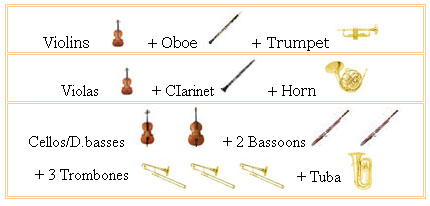 In the above diagram some instruments can be substituted (Fr., Clar for the oboe, cellos for the viola, and English horn for the clarinet.
Such groupings are used for preference in loud passages or for a heavy piano effect. (*7) Score References & Musical Examples Using GPO: Click on Play Button below to Play from the Score
Click on Play Button below to Play from the Score
Click on Play Button below to Play from the Score
Other references: • cf. Snegourotchka, Section 231 - Cellos and Violas and Bassoon and Trombones, with Double Basses and Bassoon and Tuba doubling an octave below. (this was example 95 in the original text) No.96. Ivan the Terrible , Act III, before Section 66 - Bass Clarinet and Horn, with Double Basses and Contrabassoon and Tuba doubling an octave below. Click on Play Button below to Play from the Score
Other References: • Servilia, Section 168 - Cellos and Trombones and Bass Clarinet playing in unison, with Violas and Trombones doubling an octave above,and with Double basses and Tubas and Bassoon doubling an octave below. • Pan Voyevoda, Section 224 - Violins and Bassoons and Horn and Violin and Clarinet and Trumpet in unison (Stopped notes in the brass) • Mlada, Act III, after Section 23 - Violas and 2 Clarinets and Bass Trumpet in unison. • Ivan the Terrible, Overture 4th bar after Section 9 - Violas and Cellos and English Horn and 2 Clarinets and Bass Clarinet and 2 Bassoons and 4 Horns in unison (the melody simplified in the horns). 1. Professor Belkin Comments: Such doublings are quite massive, and should be considered as part of tutti writing, where power and fullness take precedence over transparency. They are necessary at times, but can easily become monotonous if over-used. As a rule: the MORE instruments double a line, the LESS distinct its character. To keep the sound transparent, one possibility is heterophonic doubling: instead of doubling EXACTLY, one or more of the instruments will have slight rhythmic simplifications or ornamentations. For technical reasons, double bass parts are often simplified in this way, but the principle can be used elsewhere. Of course the “main” line must be balanced to dominate! 2. Professor Belkin Comments: Notice that in these cases the exact NUMBER of woodwind is not very important, since the sound is already quite thick. 3. Professor Belkin Comments: This particular doubling is also extremely common when the bass line has a vigorous character. The bassoons add “bite” to the line. Note that the contrabassoon adds MUCH more “growl” than the bassoon does. Its use is therefore more limited. 4. Professor Belkin Comments: Although to some extent these choices are a matter of style, the beginner should aim for TRANSPARENCY first. Overuse of doubling timbres easily engenders grayness. 5. Professor Belkin Comments: This is an important point: usually one combines colors for BLEND. Relatively few of the more heterogeneous combinations are effective. 6. Professor Belkin Comments: The cello adds poignancy to the sound; the horn adds nobility. 7. Professor Belkin Comments: Again, these are MASSIVE effects, for tutti passages. They are usually effective in INVERSE proportion to their quantity. Perhaps the most important principle of orchestral color is: SAVE IT UP, instead of using it all the time! Mozart is the master of this. |