Lesson 7
|
Lesson 7 - MELODY - Wood-wind - Unison & Octaves
GARRITAN INTERACTIVE
PRINCIPLES OF ORCHESTRATION
by Nikolay Rimsky-Korsakov Chapter II
MELODY Part 2 - Unison & Octaves in the Wood-wind Lesson Notes: In this lesson we will continue our discussion of Melody in the Wood-Wind. We well delve into unison and octaves in wood-wind melody. As mentioned in the previous lesson, wood-wind instruments have more diversity in tone color than any other instrument group in the orchestra
Combinations in unison. The combination of two different wood-wind instruments in unison yields the following tone qualities: a) Flute  and Oboe and Oboe  A quality fuller than that of the flute, sweeter than that of the oboe. Played softly, the flute will predominate in the low, the oboe in the upper register. Score References & Musical Examples Using GPO:
No. 52. Snegourotchka, Section 113 - Flute and Oboe in unison. Click on Play Button below to Play from the Score
and Clarinet  A quality fuller than that of the flute, duller than that of the clarinet. The flute will predominate in the lower, the clarinet in the higher register. Score References & Musical Examples Using GPO:
No. 53. Legend of Kitesh, Section 330; also 339 and 342 - Flute and Clarinet in unison. Click on Play Button below to Play from the Score
There are also instrument and full versions c) Oboe and Clarinet A fuller quality than that of either instrument heard separately. The dark, nasal tone of the oboe will prevail in the low register, the bright, "chest" quality of the clarinet in the high compass. Score References & Musical Examples Using GPO:
No. 54. Snegourotchka, Section 115 - Oboe and Clarinet in unison. Click on Play Button below to Play from the Score
Other References: d) Flute and Oboe and Clarinet Very full in quality. The flute predominates in the low register, the oboe in the middle, and the clarinet in the high compass. References: e) Bassoon  and Clarinet and ClarinetVery full quality. The gloomy character of the clarinet prevails in the lower register, the sickly quality of the bassoon in the higher. References: • Mlada, Act II, after Section 49. f) Bassoon and Oboe andg) Bassoon and Flute The combinations of f) and g) above, as well as Bassoon and Clarinet and Oboe; as well as Bassoon and Clarinet and Flute are very seldom found except in certain orchestral tutti, where they produce increased resonance without creating a fresh atmosphere. But in such combinations, the range of which is practically restricted to the limits of the third octave, the low notes of the flute will predominate in the lower third of this register, and the high notes of the bassoon in the middle third. The clarinet, weak in the middle compass will not stand out prominently in this particular combination. h) Bassoon and Clarinet and Oboe and FluteThis combination is equally rare. The colour is rich, and difficult to define in words. The tone of each instrument will be separated from the others more or less in the manner detailed above. Score References & Musical Examples Using GPO:
No. 55. Snegourotchka, Section 301 - Flute and Oboe and Clarinet and Bassoon in unison. Click on Play Button below to Play from the Score
Other References: The process of combining two or more qualities of tone is unison, while endowing the music with greater resonance, sweetness and power, possesses the disadvantage of restricting the variety of colour and expression. Individual timbres lose their characteristics when associated with others. Hence such combinations should be handled with extreme care. Phrases or melodies demanding diversity of expression alone should be entrusted to solo instruments of simple timbres. The same applies to the coupling of two instruments of the same kind, such as 2 flutes, 2 oboes, 2 clarinets, 2 bassoons. The quality of tone will lose nothing of its individuality, and will gain in power, but its capacity for expression will be diminished accordingly. An instrument enjoys greater independence and freedom when used as a solo than when it is doubled. The use of doubling and mixed timbres is naturally more frequent in loud passages than in soft ones, also where expression and colour is broad rather than individual or intimate in character. (*1) I cannot refrain from mentioning how greatly I dislike the method of duplicating all the wood-wind, in order to balance a group of strings, reinforced out of all reason, to 'suit the ever-growing dimensions of concert halls. I am convinced that, artistically speaking, a limit should be set to the size of both concert room and orchestra. The music performed at these super-concerts must be specially composed on a plan of its own — a subject which cannot be considered here. Combinations in octaves.
When the melody is entrusted to two wood-wind instruments in octaves, the usual arrangement producing natural resonance is: The combination of flute and bassoon in octaves is rare on account of the widely separated registers of the two instruments. Deviation from the natural order, such as placing the bassoon above the clarinet or oboe, the clarinet above the oboe or flute etc., creates an unnatural resonance occasioned by the confusion of registers, the instrument of lower compass playing in its high register and vice versa. The lack of proper relationship between the different tone qualities then becomes apparent. (*2)
The use of two instruments of the same colour in octaves, e. g. 2 flutes, 2 clarinets or 2 bassoons etc., if not exactly to be avoided is certainly not to be recommended, as the instruments, playing in different registers will not correspond one with the other. Nevertheless this method may be safely employed when stringed instruments, areo or pizzicato double the two members of the wood-wind, and especially in the middle compass. The process is most satisfactory for repeated notes or sustained passages. (*3) Score References & Musical Examples Using GPO:
As in the strings, so in the wood-wind it is advisable to double in octaves any melody situated in the extremely high or low compass; an octave lower in the first case, an octave higher in the second. Thus the piccolo will be doubled by the flute, oboe or clarinet an octave lower; the double bassoon will be doubled by bassoon, clarinet or bass clarinet an octave higher. (*4) 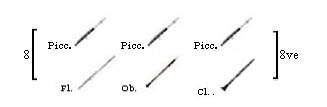 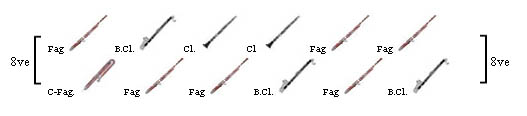 Score References & Musical Examples Using GPO: No. 61. Mlada*, Act II, Lithuanian Dance, Section 32 - Piccolo and Eb Clarinet in octaves. Doubling in two, three and four octaves.
In such cases the student should follow the above-mentioned rules, and should take care not to infringe the natural order: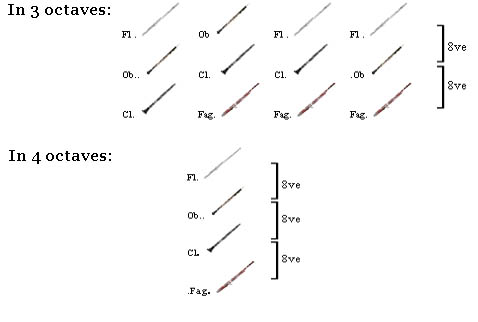 Score References & Musical Examples Using GPO:Examples of melody doubled in five octaves are extremely rare; in such cases the strings participate in the process.
Melody in thirds and sixths . Melodic progression in thirds and sixths demands either two instruments of the same colour (2 Flutes, 2 Oboes, 2 Clarinets, 2 Bassoons) or instruments of different colours in the normal order of register:   When the doubled parts progress in thirds or sixths, the following method is advisable:  In the case of tripling, the following arrangement may be adopted: 
 There are certain complicated methods which involve doubling: 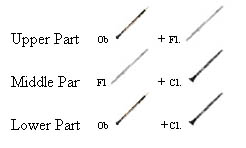
Click on Play Button below to Play from the Score
SUMMARY EXERCISES:
Professor Comments:
1. Professor Belkin Comments: Melodic doubling of the same instrument at the unison, e.g. 2 flutes in unison gives no really new timbre, and easily sounds out of tune (2 instruments are not enough to create the “chorus effect” seen in a string section). The result is also not very much louder than one instrument, and the effect of a solo woodwind as an “intimate voice” in the orchestra is lost. Overuse of this kind of doubling is a common beginner’s mistake and is best avoided. Note the we are here referring to a melody doubled ONLY in two instruments of the same kind. Combining, say, 2 flutes with a section of violins is fairly common: The goal here is not the flute timbre in itself but rather to soften the violin sound. Doubling woodwind at the unison with MORE than two of the same instrument, e.g. 4 clarinets in unison, is sometimes useful when a rather crude, rustic sound is desired. Of course is band scoring this practice is quite common. 2. Professor Belkin Comments: The melodic ombination of high flute and high bassoon, doubled at TWO octaves apart with nothing in between, is a favourite of Mozart’s. 3. Professor Belkin Comments: This doubling is more “neutral” sounding, since there is little timbral variety. With discrete accompaniment, it can be quite useful on occasion. 4. Professor Belkin Comments: This is because pitch perception at extremes is harder than in the middle register. 5. Professor Belkin Comments: These examples illustrate the use of the woodwind as a MASSED CHOIR, rather than as soloists. There are actually various interesting sounds thus made available; however it should be remembered that the more colors one combines at once, the less effect they have afterwards. One of the simplest, but deepest, principles of Mozart’s orchestration is: a wind instrument with an important solo often will rest for a while before, so the entry of the new color remains fresh. This is an important reason for avoiding overuse of doubled sounds in general. The grand master of heterogeneous wind doublings is Wagner. 6. Professor Belkin Comments: The use of flutes in thirds doubled two octaves lower by bassoons in thirds is often found in Sibelius. |
 Melody in the Wood-wind: Three and Four Octave Displacement Exercise